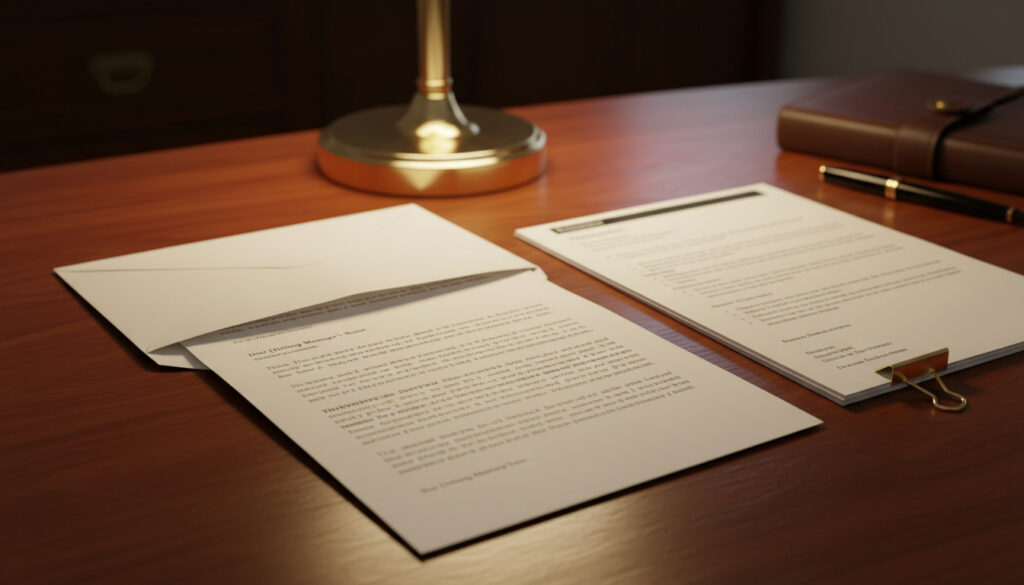
What Is a Cover Letter – Definition, Purpose and Examples
A cover letter is a customized 3-4 paragraph narrative document that accompanies job applications to introduce candidates to potential employers. Unlike structured resumes that present factual achievements in bullet points, this document tells the story connecting your background to specific job requirements, explaining both your capabilities and your motivations for pursuing the role.
Hiring managers utilize this narrative component to assess cultural fit and genuine interest beyond qualifications listed in application materials. Cover Letter vs. Resume comparisons reveal that while resumes prove you can perform job functions, cover letters demonstrate why you want this specific position and how your personality aligns with organizational goals.
What Is a Cover Letter?
A customized 3-4 paragraph narrative document submitted with job applications to introduce the candidate and explain their interest in the specific position.
Serves as a personal pitch that brings your resume to life, transforming factual achievements into compelling narratives that highlight your ideal fit for the role.
Typically 3-4 paragraphs of flowing narrative text, significantly shorter than the 1-3 pages standard for resumes.
Structured as a professional business letter with a conversational tone that connects with the reader and displays personality.
Key Insights:
- Acts as a bridge between resume facts and specific job requirements
- Must be tailored to each individual position and company
- Written in conversational narrative rather than bullet-point format
- Demonstrates research into company culture, mission, and goals
- Highlights specific examples not detailed in the accompanying resume
- Explains what specifically attracted you to the role and organization
- Enhances candidacy significantly in competitive job markets when included
| Element | Description | Best Practice |
|---|---|---|
| Header | Contact information and date | Maintain professional formatting consistent with your resume |
| Salutation | Greeting addressing the hiring manager | Use specific name when available; otherwise use title |
| Opening | Expression of interest in the position | Mention how you learned about the job opportunity |
| Body | Narrative explaining qualifications and fit | Connect specific experiences directly to job requirements |
| Closing | Reiteration of interest and next steps | Include a professional call to action |
| Signature | Formal sign-off | Use professional closing with typed name and contact details |
| Scope | Focus of content | Address present capabilities and future goals relevant to the role |
The purpose of a cover letter centers on making hiring managers examine your resume in greater detail by highlighting why you’re the ideal candidate. Analysis shows that this document explains why you want this specific position rather than proving general capability.
What Should a Cover Letter Include?
Essential Structural Components
The opening paragraph must express your specific interest in the position while briefly mentioning how you discovered the job posting. This section sets the narrative tone and immediately establishes relevance to the particular opportunity.
Body paragraphs should expand on key qualifications by connecting your experience directly to job requirements. Rather than repeating resume bullet points, provide specific examples that demonstrate how your background prepares you for this unique role. This section must demonstrate that you’ve researched the company’s culture, mission, and goals thoroughly.
The closing paragraph reiterates your interest in the position and includes a professional call to action, encouraging the hiring manager to review your attached resume or schedule an interview.
Length and Format Specifications
Standard cover letters maintain a length of 3-4 paragraphs, formatted as flowing narrative text rather than scannable bullet points. The document follows professional business letter conventions while maintaining a conversational tone that allows your personality to emerge. Each submission should be tailored to the specific job description, incorporating relevant skills, experience, and keywords.
Every cover letter must be customized for the specific position. Generic templates that fail to address the particular company’s mission or the job’s unique requirements typically fail to advance candidates to interview stages.
How to Write a Cover Letter
Crafting Your Opening
Begin by clearly stating the position you’re applying for and explaining what specifically attracted you to the opportunity. Mention any mutual connections or how you discovered the posting. This initial paragraph should immediately signal that you’re not submitting a generic application but have targeted this specific role intentionally.
Developing the Body Content
Select two or three key qualifications from the job description and craft narratives around relevant experiences from your background. For example, if your resume states that you collaborated with 15+ team members to deliver 10 client projects with a 98% success rate, your cover letter should explain how this experience specifically prepares you for the target position’s collaboration requirements.
Common Pitfalls to Avoid
Avoid simply restating your resume in paragraph form. The cover letter should complement, not duplicate, the factual information found in that document. Additionally, avoid generic phrases that could apply to any position or company; specific references to company achievements or values demonstrate genuine interest.
Transform quantitative resume achievements into qualitative explanations of relevance. Rather than listing metrics again, explain how those measured results demonstrate your capacity to solve this specific employer’s challenges.
Do You Need a Cover Letter?
Cover letters are not universally mandatory, and certain application systems may not provide submission options for this document. Research indicates that when optional submission is available, including a well-crafted letter significantly enhances your candidacy in competitive job markets. Per a més informació, consulta starkes Passwort erstellen.
If the application platform provides an opportunity to submit this narrative document, best practices strongly recommend inclusion. The additional context provided often differentiates candidates with similar qualifications by demonstrating communication skills and genuine enthusiasm for the specific role.
Some digital application portals lack functionality for uploading cover letters, even when hiring managers might prefer to receive them. In such cases, focus on optimizing your resume and professional profiles to communicate your narrative.
What Is the Step-by-Step Writing Process?
- Research Phase: Investigate the company’s recent achievements, culture, and mission to identify specific connections to your background.
- Requirement Analysis: Review the job description to identify three core competencies the employer seeks.
- Opening Draft: Compose a paragraph expressing specific interest and mentioning how you discovered the opportunity.
- Body Development: Write 1-2 paragraphs connecting your specific experiences to the identified job requirements using narrative examples.
- Closing Composition: Draft a final paragraph reiterating interest and requesting an interview or resume review.
- Alignment Review: Verify that every paragraph addresses the specific job description rather than generic qualifications.
What Are Common Cover Letter Misconceptions?
- Documents should be limited to 3-4 paragraphs
- Content must be tailored to each specific job description
- Purpose is to explain motivation and cultural fit, not just list skills
- Optional status does not diminish strategic value
- Cover letters should repeat resume content verbatim
- One standard letter works for multiple applications
- Length should approach that of a resume
- Hiring managers never read these documents
How Do Cover Letters Function in Modern Hiring?
Cover letters and resumes operate as complementary documents that together tell your complete professional story. Human resources professionals note that resumes provide the factual context of your capabilities, while cover letters supply the motivational framework showing why you’re pursuing this specific trajectory.
In contemporary recruitment, these documents serve distinct screening purposes. While resumes face initial scanning for keywords and qualifications, cover letters often determine which qualified candidates advance to interview stages based on demonstrated communication ability and cultural alignment. Career experts emphasize that this narrative component remains relevant despite technological advances in hiring.
What Do Career Experts Say?
A cover letter serves as your personal pitch that brings your resume to life. While your resume presents facts and measurable achievements, your cover letter tells the story connecting your background to the job requirements.
— TealHQ Career Research
The primary purpose is to make the hiring manager examine your resume in greater detail by highlighting why you’re the ideal fit for the specific position and company.
What Defines an Effective Cover Letter?
An effective cover letter functions as a tailored 3-4 paragraph narrative that bridges your factual resume qualifications with the specific requirements and culture of your target employer. By expressing genuine motivation, demonstrating company research, and providing contextual examples of your capabilities, this document significantly enhances your candidacy in competitive job markets. While not always mandatory, including this personalized pitch when submission options exist remains a best practice for serious applicants.
Frequently Asked Questions
Can I use the same cover letter for multiple job applications?
No. Each cover letter must be tailored to the specific job description, incorporating relevant skills, experience, and keywords unique to that position and company.
Should my cover letter match my resume formatting?
Yes. Maintain consistent professional formatting between documents, including header styling and contact information, to present a cohesive application package.
How can I demonstrate company knowledge effectively?
Reference specific company achievements, mission statements, or cultural values in your body paragraphs, connecting these elements directly to your own professional approach.
What is the best way to express my motivation for the role?
Explain specifically what attracted you to this position rather than generic interest, mentioning particular responsibilities or company initiatives that align with your career goals.
Is it acceptable to submit a cover letter when not specifically requested?
Yes. If the application system provides submission options, including this document demonstrates initiative and can significantly enhance your candidacy even when optional.
How do cover letters and resumes differ in tone?
Resumes use straightforward, achievement-focused language with action verbs, while cover letters employ a conversational tone designed to connect with the reader personally.
Can I include information not found in my resume?
Absolutely. The body paragraphs should expand on key qualifications with specific examples and narratives that provide context beyond the factual statements in your resume.
More related posts
 How to Get Rid of Fruit Flies in Kitchen: Fast Traps & Prevention
 Randy Travis: Health, Arrest, Divorce, Net Worth Story
 Miranda Lambert: Age Gap, Health & Relationship History
 West Indies vs Bangladesh match scorecard: head-to-head records
 Things to Do in Winnipeg This Weekend: Events & Guides
 Royal Challengers Bengaluru vs Mumbai Indians – Head-to-Head Stats
 Guy Fieri New Look – 58th Birthday Style Shift
 Jane Lynch: Career, Sobriety, Advocacy & Common Myths
